
Best Pitching Aids for Velocity: 2026 Guide
Table of Contents
- What the Best Pitching Aids for Velocity Actually Do
- Pitching Training Aids for Velocity: Weighted Balls and Plyo Balls
- Fastpitch Softball Pitching Aids: Leg Drive and Lower-Body Power
- Pitching Aids for Mechanics: Training Tools That Build Muscle Memory
- Pitching Drills to Increase Velocity: A Complete Training Plan
- Velocity Measurement and Realistic Progress Tracking
- Conclusion
- Frequently Asked Questions
Last Updated: October 8, 2026
What the Best Pitching Aids for Velocity Actually Do
The best pitching aids for velocity do one job: make the correct movement feel obvious, repeatable, and measurable. The Xelerator builds fastpitch training tools around that idea.
Here is the tension most buyers miss. Velocity is not one skill but the sum of leg drive, hip rotation, arm path, and release point working in sequence.
That is why pitching training aids are often grouped into four categories: resistance tools that build arm strength, mechanics trainers that groove muscle memory, lower-body tools that develop ground force, and feedback devices that measure whether any of it worked. The American Sports Medicine Institute's throwing injury research has repeatedly shown that throwing workload and mechanics, not effort alone, drive both velocity and arm health.
Below, we break down each category, name what it trains, and show how to build a weekly plan around it.
Pitching Training Aids for Velocity: Weighted Balls and Plyo Balls
Weighted balls and plyo balls are the most direct velocity tool available, and the most misused. The principle is simple: throwing a slightly heavier or lighter implement teaches the arm to accelerate faster than a game ball allows.
The evidence behind them is real but narrow. The National Strength and Conditioning Association and sports medicine bodies generally support weighted-implement throwing as part of a structured program, not as a standalone fix. The American Sports Medicine Institute's throwing injury research has repeatedly tied throwing workload and mechanics, not effort alone, to both velocity and arm health.
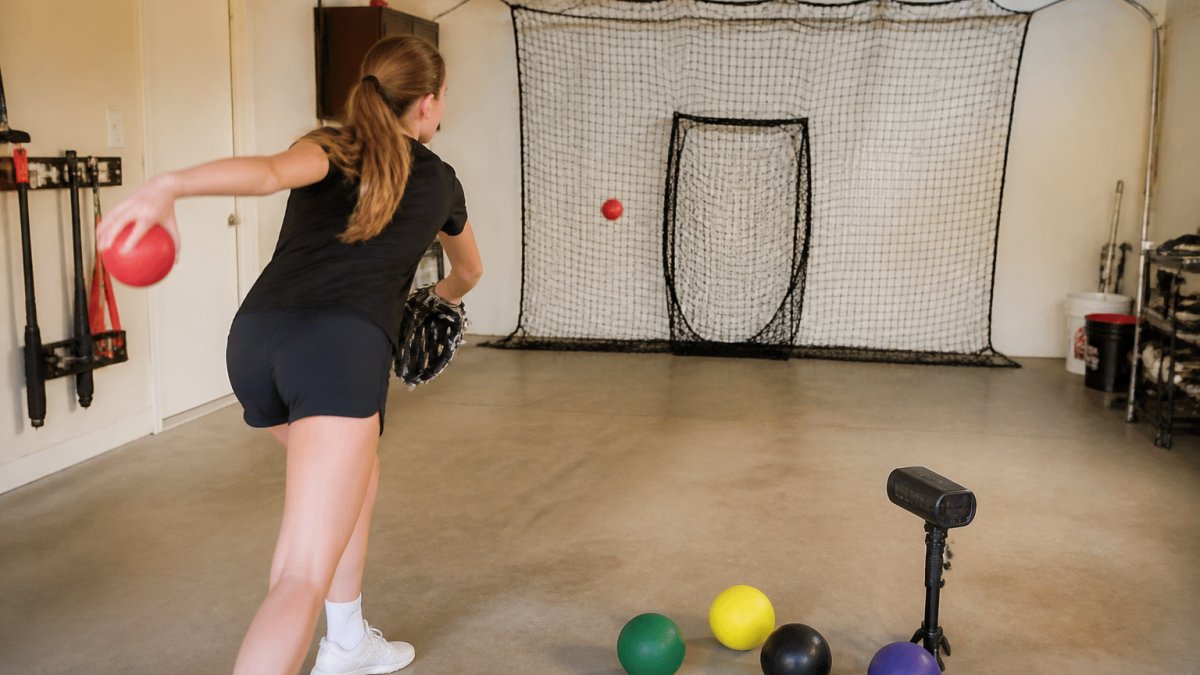
How Weighted Balls Build Arm Strength and Speed
Weighted balls build arm strength through progressive overload, the same principle behind any strength program. Start light, add load gradually, and let the arm adapt. Jumping straight to the heaviest ball because it feels like real work is a fast track to elbow pain.
The practical sequence most coaches use:
- Begin with underload balls to train arm speed
- Add overload balls in small doses to build strength
- Return to a game ball to transfer the new speed
- Track every throw, because volume is the variable that matters most
A few guardrails separate a productive weighted-ball block from a risky one:
- Age and experience. Youth pitchers who have not finished growth-plate development should treat weighted balls as a light, low-volume supplement, if they use them at all. Serious overload work is reserved for older, mechanically sound pitchers with a coach supervising.
- Volume. Keep weighted-ball throws to a small fraction of total weekly throwing. The bulk of a pitcher's volume should still come from game-weight throws.
- Frequency. Two to three weighted-ball sessions per week is a common ceiling. Daily heavy-ball work is a red flag, not a shortcut.
- Progression. Add load in small steps and hold each for a week or more. If arm speed drops or the pitcher reports elbow or shoulder discomfort, back off immediately.
- Mechanics first. Weighted balls amplify whatever pattern the pitcher already has. Groove a clean arm path with a game ball before adding load.
Plyo Ball Workouts for Rotational Power
Plyo ball work trains rotational power by forcing the hips and torso to fire before the arm. The throw starts at the ground, travels through the hips, and finishes at the fingertips. Train only the arm and the lower body never learns its job.
A simple plyo circuit runs three sets of five throws, alternating underload and overload, with full recovery between sets. Quality beats quantity every time. Stop the set the moment arm speed drops.
Plyo work also fits neatly into a phase-based plan:
- Off-season: higher volume, more overload emphasis, more total sessions per week.
- Pre-season: shift toward underload and game-ball transfer, reduce heavy-ball volume.
- In-season: maintain with a small number of light plyo throws; protect game-day readiness.
- Post-season: rest and rebuild, then reintroduce load gradually.
Choosing Between Weighted Balls and Plyo Balls
Both tools train arm speed, but they are not interchangeable. Weighted balls lean toward strength and overload; plyo balls lean toward speed and rotational sequencing. A pitcher who lacks arm strength benefits more from controlled overload; one who is strong but slow benefits more from underload and plyo work. Many programs use both in different doses across the week. Buy one category first, learn how the pitcher responds, then add the second.
Fastpitch Softball Pitching Aids: Leg Drive and Lower-Body Power
Fastpitch softball pitching aids that target leg drive address the biggest velocity leak in most young pitchers.
Leg-drive trainers give the pitcher a physical reference for the push, a resistance band anchored behind the mound, a raised platform, or a marked drive line.
What most guides miss is that leg drive and hip rotation are not the same thing. A pitcher can push hard and still rotate slowly. Train both.
Pitching Aids for Mechanics: Training Tools That Build Muscle Memory
Pitching aids for mechanics exist to build muscle memory, which only forms through correct repetition.
These tools fall into a few types. Arm-path guides keep the elbow and hand on the correct plane.
Here is the honest limitation. A mechanics trainer cannot diagnose the problem, it only reinforces a movement you have already identified as correct.
For beginners, start with one constraint at a time. Adding three tools at once teaches nothing. For advanced pitchers, mechanics work is maintenance, not overhaul.
Pitching Drills to Increase Velocity: A Complete Training Plan
Pitching drills to increase velocity work only inside a structured week. Random throwing does not build speed; a plan does. Here is how we would lay out a training week using the aids above without overloading the arm.
| Day | Focus | Tool | Duration |
|---|---|---|---|
| Monday | Arm strength | Weighted balls | 20 min |
| Tuesday | Leg drive | Leg-drive trainer | 25 min |
| Wednesday | Recovery | Light catch, bands | 15 min |
| Thursday | Mechanics | Mechanics trainer | 20 min |
| Friday | Rotational power | Plyo balls | 20 min |
| Saturday | Command | Target net | 30 min |
| Sunday | Rest | None | Off |
That table is a starting template, not a fixed prescription. The right plan depends on the pitcher's age, experience, and where the season sits. A 12-year-old in the off-season and a 17-year-old in the middle of a playoff run should not train the same way.
Warm-Up and Throwing Program
Every session starts with a warm-up, no exceptions: jog, band work for the shoulder and rotator cuff, then a progressive long-toss build. The arm needs blood flow and range of motion before it produces speed.
The throwing program itself moves from easy to hard. Short toss, then long toss, then mound work. The American Academy of Orthopaedic Surgeons notes that proper warm-up and gradual progression are central to reducing throwing injuries in young athletes.
Progressive Overload and Recovery
Progressive overload means adding a small amount of stress each week, then backing off to let the body adapt. Recovery is not the opposite of training. It is part of it. A pitcher who throws hard every single day gets slower, not faster, because the arm never rebuilds.
Track pitch count. Track throwing days. Give the arm at least one full rest day per week. When velocity climbs, hold the load steady for a week before adding more.
Adjusting the Plan by Age and Experience
The same weekly structure scales differently depending on who is throwing:
- Beginners and youth pitchers. Fewer tools, lower volume, more rest. One mechanics constraint and one light plyo or band session per week is plenty. Skip heavy overload until mechanics and growth are settled.
- Intermediate pitchers. Add a second weighted-ball or plyo session, but keep game-weight throwing as the majority of weekly volume. Introduce a radar gun to confirm the plan is working.
- Advanced pitchers. Can handle more total volume and more overload, but only with a coach monitoring mechanics and arm response. Advanced training without oversight is where overuse injuries hide.
Adjusting the Plan by Training Phase
A single weekly template does not fit every month of the year. Most programs shift emphasis across four phases:
- Off-season: build. Higher volume, more strength and overload work, more total sessions.
- Pre-season: transfer. Reduce heavy load, increase underload and game-ball throwing, sharpen mechanics.
- In-season: maintain. Low-volume plyo and band work, protect game-day readiness, prioritize recovery.
- Post-season: rest and rebuild. Step away from high-intensity throwing, then reintroduce load gradually.
Reassessment Cadence
A plan that never gets checked is just a habit. Reassess every two to four weeks:
- Re-test peak and average velocity with the same radar setup each time.
- Review command, if speed is up but the strike zone is gone, the plan is not working.
- Check arm response, soreness that lingers past a normal recovery window is a signal to reduce load.
- Adjust one variable at a time so you can tell what actually moved the number.
Velocity Measurement and Realistic Progress Tracking
Velocity measurement turns guesswork into data, and data keeps a training plan honest.
Track three things: peak velocity, average velocity, and command. Peak tells you the ceiling. Average tells you what shows up in a game. Command tells you whether the extra speed is usable.
Realistic progress is slower than most families expect. Meaningful velocity gains in fastpitch typically build over months of consistent work, not weeks.
Conclusion
Building real velocity takes the right tools, a structured plan, and the patience to let the arm adapt. The hard part is knowing which aid fixes which problem, and that is what The Xelerator was built for. Our fastpitch pitching training tools are made in the USA and ship with either a premium leather or foam ball, so beginners and advanced pitchers alike get a tool matched to their stage.
Frequently Asked Questions
Can pitching training aids improve throwing velocity?
Yes. Weighted balls, plyo balls, and leg-drive trainers build the strength and mechanics that increase pitching velocity. Research on over- and underload throwing shows measurable gains when tools are used in a structured program. The key is progressive overload and consistent use, not occasional practice. Pairing aids with a radar gun gives pitchers feedback so they can track real gains over weeks, not days.
How should pitchers use training aids safely?
Always warm up thoroughly before using weighted balls or plyo balls. Start with lighter weights and fewer reps, then increase gradually. Limit high-intensity throwing to two or three sessions per week and monitor pitch count. Watch for arm fatigue or soreness, and stop if pain appears. Young pitchers should work under a coach or parent who can check mechanics. Recovery days matter as much as training days for arm health.
Which pitching aids help improve fastpitch softball velocity?
Fastpitch softball pitching aids that target velocity include weighted balls, plyo balls, resistance bands, leg-drive trainers, and mechanics trainers. A target net and radar gun help with command and feedback. The Xelerator offers specialized fastpitch softball pitching training tools, with premium leather or foam ball options. Choose aids that match the pitcher's age, experience, and training phase, and use them as part of a complete throwing program.
How often should pitchers use velocity training aids?
Most pitchers see results with two to three focused velocity sessions per week, with at least one recovery day between them. Weighted-ball and plyo-ball work fits well after a warm-up and before regular pitching. Leg-drive and mechanics trainers can be used more often, even daily, because they are lower intensity. Track throws and rest to avoid overuse. Consistency over months matters more than daily intensity.